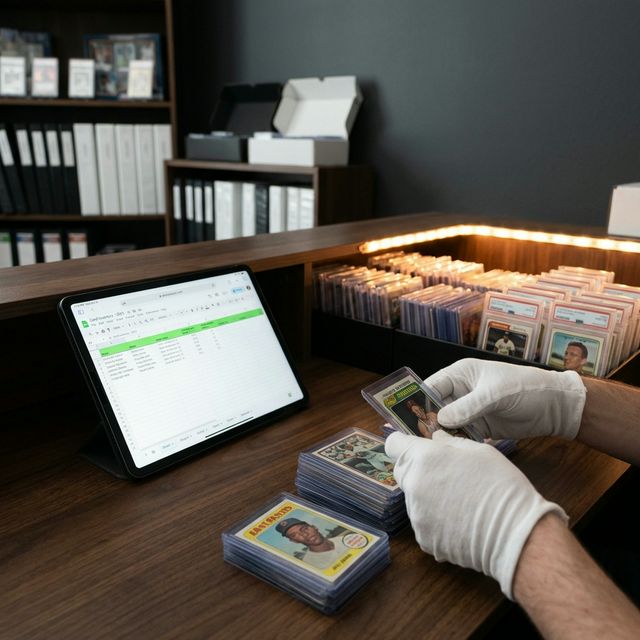
If you are deeply invested in your trading card collection, treating it like a casual hobby is a fast track to losing money. Whether you're a long-time player or an investor aiming to maximize your ROI, understanding how to mathematically track and manage your assets is non-negotiable.
As someone who spends their days testing software architectures and managing databases, I realized early on that the way most collectors track their portfolios is fundamentally broken. We focus too much on "Market Value" and completely ignore the actual financial mechanics of our collections.
In this guide, we are going to strip away the hype. We will break down the exact math you need to track your True Profit, expose the biggest mistake collectors make at the trade table, and look at why securing your data offline is your best defense against subscription fatigue.
🛑 The "Market Price" Illusion (Paper vs. Realized Gains)
Most collection apps give you a massive, shiny "Total Value" number at the top of your screen. It feels great to see your collection is worth $10,000. But that number is a dangerous illusion.
That is Paper Value (Unrealized Gains). It doesn't factor in selling fees, shipping, or market liquidity. More importantly, it doesn't factor in what you actually paid. To track your collection like a pro, you must separate your data into three distinct buckets:
- Cost Basis: The actual cash out of your pocket to acquire the card (including shipping and grading fees).
- Realized Gains: The actual cash profit sitting in your bank account after a card is sold.
- True ROI: Your total net equity calculated against your original sunk cost.
If your tracker isn't separating your banked cash from your hypothetical paper value, you are flying blind.
🧮 The "Rollover Cost Basis" Trap in Trades
This is where 90% of collectors bleed money without realizing it. Let's look at a real-world scenario.
- You buy a raw Charizard ex for $120.
- Months later, it spikes in value to $280.
- At a convention, you trade that raw Charizard plus $720 cash for a PSA 10 Charizard ex (Current Market Value: $1,000).
Most trackers (and our own brains) will log that new PSA 10 slab as if your entry price was $1,000. That is mathematically wrong. Your actual Sunk Cost is only $840 ($120 original card cost + $720 cash).
If that PSA 10 drops to $900 and you panic sell, a standard app will tell you that you took a $100 loss. In reality, your Rollover Cost Basis was only $840, meaning you still made a +$60 net profit.
If you aren't carrying the original sunk cost of a traded card into your new card, your data is completely disconnected from reality.
🔐 The Danger of Cloud-Based Trackers
For years, the gold standard for tracking this kind of complex math was a massive Excel spreadsheet. But updating rows and columns on your phone at a crowded convention table is clumsy and slow.
The modern alternative? Flashy, cloud-based SaaS apps. But these come with two massive risks for serious collectors:
- The Data Hostage Situation: They charge a $10/month subscription just to view your own collection data. If you stop paying, you lose access to your ledger.
- Privacy Risks: They broadcast your $15,000 collection value to their remote servers, making your financial data a potential target if there is a security breach.
🛠️ The Offline Solution
I couldn't find a mobile tool that calculated Rollover Cost Basis automatically, separated realized vs. unrealized gains, and kept my data 100% locally secure.
So, I built one.
It's called Honest Collector. It is a 100% offline-first vault built specifically for data nerds. It features a live multi-card Trade Fairness Calculator, automatic Rollover Basis tracking, and a PIN-protected "Privacy Mode" to instantly hide your financial values in public. Best of all? It has full Excel Import/Export capabilities and zero monthly subscriptions.
Stop doing mental math at the trade table. Take control of your data.